ATOM
- The word ATOM coined by OSTWALD
- ATOM discovered by John Dalton
- ATOM theory was proposed by John Dalton
- Fundamental particles of an atom
- Proton, Neutron, Electron
- The center of an atom is called Nucleus
- Protons and neutrons (Nucleons) are contained in the nucleus
- Electrons revolve around the nucleus in the orbits or energy shells
Discovery
| Electron (-ve) | J J Thomson |
| Proton (+ve) | Ernest Rutherford |
| Nucleus (+ve) | Ernest Rutherford |
| Neutron (no charge) | James Chadwick |
Nobel Price
| JJ Thomson | 1906 |
| Ernest Rutherford | 1908 |
| Chadwick | 1935 |
Atom models
| Plum pudding model | J J Thomson |
| Planetary model | Rutherford |
| Orbital model | Neils Bohr |
| Wave mechanical model | Schrodinger |
- Most accepted atomic model is the Bohr model
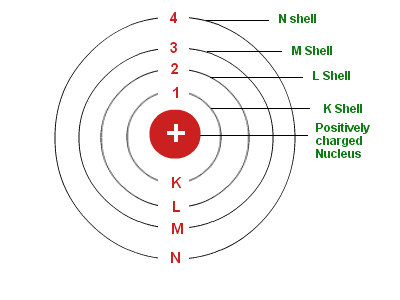
- Maximum number of electrons in a shell is 2xn2
- The number of protons present in an atom is called its Atomic Number.
- Atomic number is denoted by Z.
- Number of protons and electrons in an atom is equal
- The total number of protons and neutrons present in the nucleus of the atom is called Mass number (A).
